Repairs for software you can’t change
Software keeps running long after the assumptions it was built on stop being true. An upstream API renames a field, a vendor retires an endpoint, a client nobody can rebuild still expects the old shape. Something has to sit in between and fix it. Aftermarket.dev is a family of developer tools for that work.
The family has ten planned tools: AfterPatch, AfterAPI, Afterlife, AfterHook, AfterSchema, AfterConfig, AfterTest, AfterBridge, AfterGuard and AfterDiff. A few more ideas, such as AfterTrace and AfterInstall, are still research. See all the concepts.
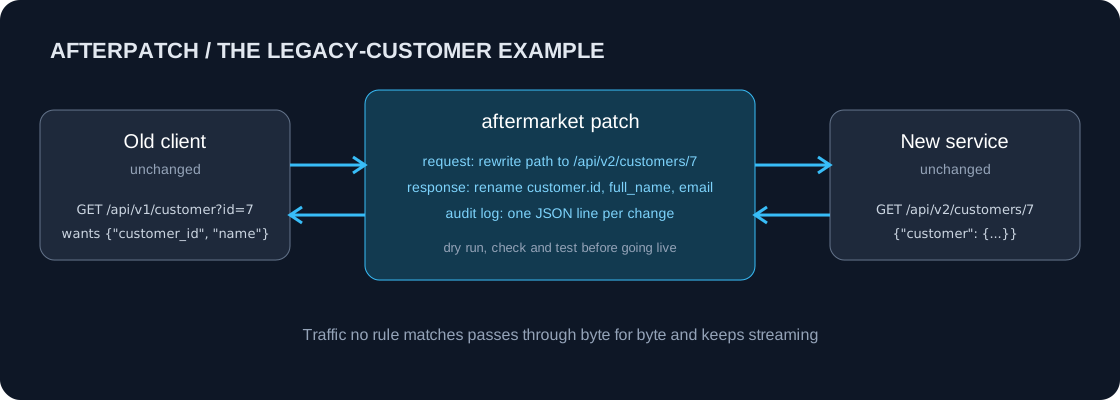
Nine tools are out. AfterPatch is a small Go proxy that repairs HTTP traffic with rules you can review. AfterAPI keeps an old client working after its whole API was replaced. AfterTest records real traffic as test fixtures with credentials removed, AfterDiff replays it against two versions of a service and lists what changed, and in its live mode compares the new version on real traffic while clients keep getting answers from the old one, AfterConfig changes a vendor’s JSON, YAML, TOML or .env config file without ever editing it, AfterHook sends a signed webhook when a file, folder, endpoint or database table changes, AfterGuard stands in front of an old app with no login and turns away what your rules don’t allow, AfterSchema keeps old reports and scripts working after a SQLite database changed shape, and AfterBridge serves an old app’s CSV exports and SQLite files as a read-only JSON API. Try them in a few minutes. The others follow one at a time, each when the one before it works. The architecture and the roadmap explain the order.